Container terminal automation and AI: what comes first

November 5, 2026

TL;DR. Container terminal automation and AI in the maritime sector no longer stall on technology. They stall on data, processes and people. Equipment is a minority share of an automation program, and an AI recommendation in a terminal is only as reliable as the data beneath it. A terminal is critical infrastructure, so the order matters: governed, trusted terminal data first, automation and AI on top. All Your BI calls that foundation Terminal Data Intelligence.
This article is for you if you lead innovation or digital transformation at a container terminal or maritime operator, and you're deciding where automation and AI in maritime operations go next. It covers what has changed in terminal automation, where AI already works, why the data layer decides the outcome, and what to settle before the RFP.
What is container terminal automation today?
Container terminal automation covers automated or remotely operated equipment at the quay, in the yard and at the gate. It includes the control software and terminal operating system integration that run that equipment.
What has changed is the scope. At the TOC Europe 2026 Tech session in Hamburg, the argument from operators, consultants and equipment makers was consistent. The industry is moving from automation based on physical certainty to autonomy capable of handling uncertainty. The menu of automation now reaches small terminals, brownfield sites and inland rail.
The same session was equally consistent on the obstacle. Technology is no longer the main one. Equipment is only 30 to 40 percent of the program; processes, IT integration and people carry the rest. The panel's view of a fully automated terminal was that it is not possible today, because exception handling, ship-side complexity and workforce acceptance are still open.
Where does AI already work in maritime and container terminal operations?
AI already creates value in focused areas of port and terminal operations: optical character recognition, process automation, predictive maintenance and safety monitoring.
Everyone has AI. Almost no one has data it can trust. The gap is still open. That is an argument for making AI usable, trusted and operationally safe.
Automated greenfield terminals show an idealized version of the future. Most operators run brownfield terminals with layered systems, long-life equipment and contractual commitments that cannot be paused while the digital architecture catches up. Moving from fragmented systems to trusted automation in one leap is hard, and that is where the quick AI fix collides with terminal reality.
Why does the data layer decide whether automation and AI pay off?
The data layer decides the outcome because AI amplifies the quality of the foundation beneath it. On inconsistent, incomplete or poorly governed data, a container terminal has not created intelligence. It has created a faster way to expose uncertainties.
A terminal is critical infrastructure. An unreliable AI recommendation affects vessel, yard, gate, equipment or customer decisions, and the operational consequences are too serious for a try-and-see approach.
The cost of getting the order wrong is AI waste: AI investment spent on top of data that cannot carry it, so the output cannot be trusted or used. All Your BI has written about that pattern at company level in The billion-dollar AI waste problem. In a terminal it is more concrete. The TOS, the equipment control system, crane management, the maintenance system and the planning tools each capture part of the reality, and automation touches all of them.
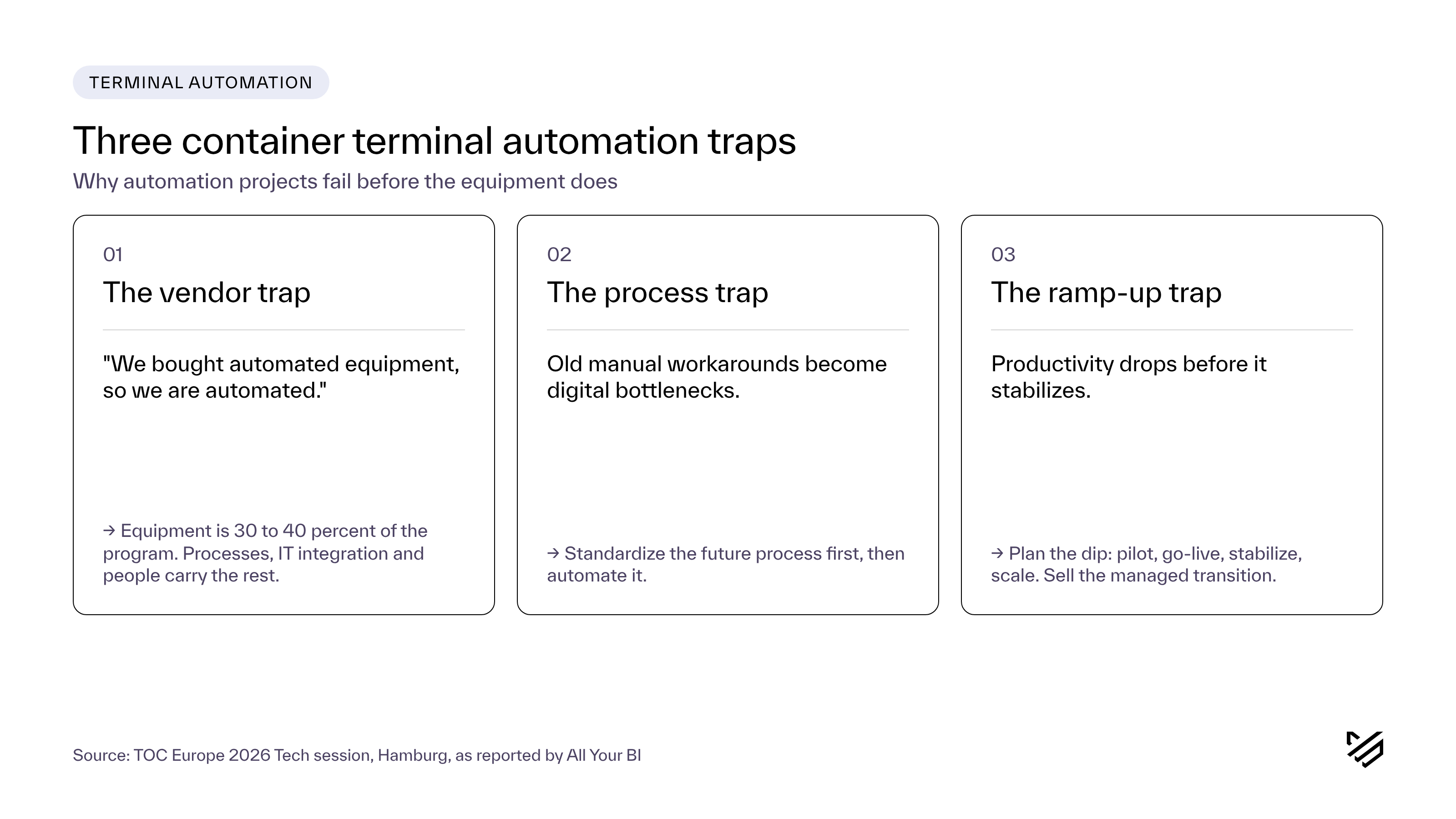
The TOC Europe session reached the same point from the automation side. Its advice to operators was to start with pain points, such as labor shortages, performance variability and safety, and to let the processes derived from them define the solution. Technology comes last. The session also warned about three traps:
- The vendor trap: we bought automated equipment, so we are automated
- The process trap: old manual workarounds become digital bottlenecks
- The ramp-up trap: productivity drops before it stabilizes unless the transition is managed
What should a container terminal settle before automating or adding AI?
Settle the data foundation, the processes it will run on and the people who will act on it, in that order, before choosing equipment or models.
The session put that into five questions to answer before issuing an RFP:
- Which pain point are we solving?
- Which future process are we standardizing?
- Which TOS and IT interfaces are on the critical path?
- Which roles, skills and decision rights will change?
- How will we test, ramp up and optimize after go-live?
Two of the five are data questions, and the other three depend on data to answer honestly. You cannot name the pain point, or measure the ramp-up, without a baseline the terminal trusts.
That baseline is Terminal Data Intelligence: the governed intelligence layer that connects a container terminal's systems into one trusted view of performance. Every number traces back to the system it came from. On that layer, an automation program can be measured against a baseline the terminal can defend. An AI recommendation comes with its lineage. The full argument is in What is Terminal Data Intelligence?. The session added two practical steps: de-risk a migration with emulation before going live, and measure people-readiness with the same rigor as technical KPIs.
A container terminal can't run itself. Digital systems, automation and AI need to extend human capability, and keep human judgment in place in critical infrastructure. Automation projects fail when terminals treat them as technology purchases rather than organizational transformations.
Terminals are human operations as well as technical systems. Decisions are made by people under time constraints, commercial pressure and operational uncertainty. Data does not replace their expertise. It gives that expertise a stronger foundation, and in a regulated industry it keeps a human accountable for what the AI recommends.
Key takeaways
- Terminal automation and AI stall on data, process and people.
- Equipment is a minority share of an automation program.
- A terminal is critical infrastructure, so try-and-see AI is too costly.
- Govern the terminal data first, then automate and add AI.
Ready to check whether your container terminal data can carry automation and AI?
Container terminal automation and AI pay off on a governed data foundation. All Your BI builds that foundation through Terminal.exe: one KPI definition, one lineage, one performance model across every system a terminal runs. Read the argument in the Terminal Data Intelligence report, or request a conversation about your automation roadmap on the Terminal.exe page.
Frequently asked questions
Is container terminal automation mainly a technology problem?
No. The TOC Europe 2026 Tech session put equipment at 30 to 40 percent of an automation program, with processes, IT integration and people carrying the rest. Automation projects fail when a terminal buys equipment before it has standardized the process, settled the TOS and IT interfaces on the critical path, and prepared the people who will run it.
Where is AI in maritime and terminal operations already used?
In focused areas: optical character recognition at the gate, process automation, predictive maintenance on equipment and safety monitoring. Each of these works where the data it runs on is consistent and governed. The open gap is wider use in operational decisions, where a terminal first needs one trusted view of its own performance.
Why should a container terminal fix its data before adding AI?
AI amplifies the foundation beneath it. On ungoverned terminal data, AI output cannot be trusted, and in critical infrastructure an unreliable recommendation affects vessel, yard, gate and equipment decisions. Fixing the data first also gives the terminal the baseline it needs to measure whether the automation or the AI delivered what the business case promised.
Can a container terminal be fully automated today?
The TOC Europe 2026 panel said no. Exception handling, ship-side complexity and workforce acceptance remain open. The menu of automation has grown and now reaches small terminals, brownfield sites and inland rail, but the panel's consensus was that a terminal remains a human operation supported by automation, with people accountable for the decisions.
What is Terminal Data Intelligence?
Terminal Data Intelligence is the governed intelligence layer that connects a container terminal's systems into one trusted view of performance. Every KPI has one definition and traces back to the system it came from. It is the foundation an automation program is measured against and an AI recommendation runs on. All Your BI delivers it through Terminal.exe.




AYBI Thinking
At AYBi, we cut through the noise to give meaning to data. It’s not about technology — it’s about real connection. With the ambition of true data wizards, we transform insights into action. Expect everything.







Latest work
At AYBi, we cut through the noise to give meaning to data. It’s not about technology — it’s about real connection. With the ambition of true data wizards, we transform insights into action. Expect everything.