What is Terminal Data Intelligence?

November 5, 2026

TL;DR. Terminal Data Intelligence is the governed intelligence layer that connects a container terminal's systems into one trusted view of performance. It gives every KPI one definition and one traceable source across operations, maintenance, finance and leadership. Terminals need it before AI, because AI amplifies the data foundation beneath it. All Your BI delivers it through Terminal.exe.
This article explains what Terminal Data Intelligence is, why optimizing one system or adding dashboards does not create it, and why it comes before AI. It's for you if your container terminal runs on a TOS, equipment data and spreadsheets, and you still can't get one agreed number.
Why does the Monday performance meeting start with the wrong question?
The Monday performance meeting should be about what to change. In many container terminals it starts with a different question: which number are we using?
Most performance conversations do not end because the cause was found. They end when someone offers a reason that sounds plausible enough. The vessel arrived late, labor was short, the weather turned. Everyone accepts it, the meeting moves on, and the real cause stays buried until it happens again.
Your terminal can have a terminal operating system (TOS), equipment data, maintenance data, dashboard reports and operational spreadsheets, and still not have one trusted view of performance. The question is less whether you have data and more whether you can trust that data enough to act on it.
If the same KPI appears differently in different reports, your leadership time goes to reconciling the past instead of improving the next shift.
What does Terminal Data Intelligence mean?
Terminal Data Intelligence is the governed intelligence layer that connects a container terminal's systems into one trusted view of how that terminal is performing. Its value is in what the data means: one definition per KPI, traceable to the system it came from.
Governed means every number can be traced back to the system it came from, so it can be explained and defended rather than just presented. A KPI then means the same thing across reports, teams, systems and leadership conversations. Operational, commercial and leadership teams work from the same foundation, and the terminal moves from fragmented reporting to decision-ready insight.
Why does optimizing one system not fix container terminal performance?
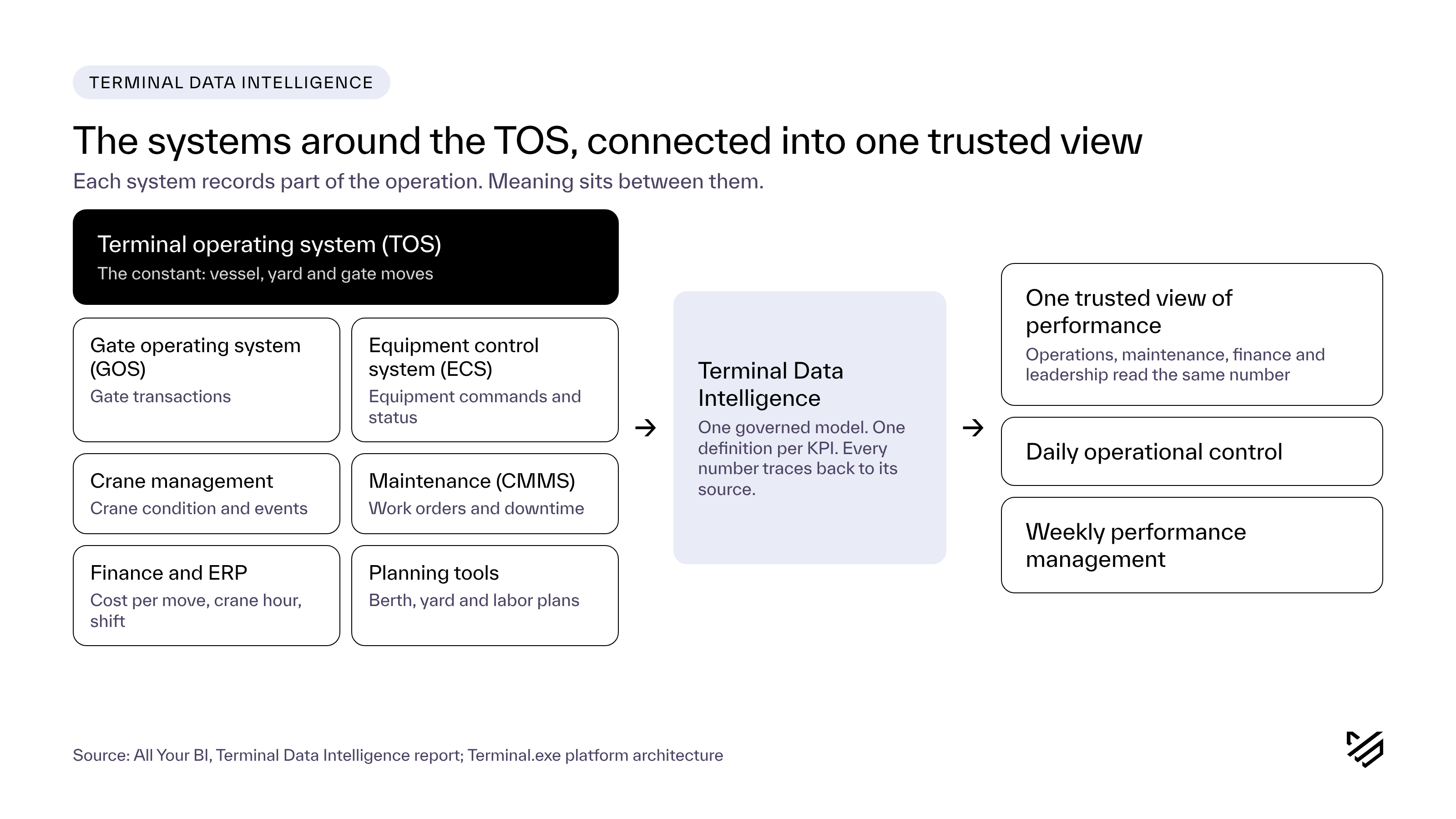
A container terminal does not run on one system. The terminal operating system is the constant, and almost every terminal runs one. What sits around it depends on how far your terminal has digitalized:
- Gate operating system (GOS), where the gate is managed digitally
- Equipment control system (ECS), in automated environments
- Crane management system, supplied with the equipment
- Maintenance management system (CMMS)
- Finance and ERP
- Planning tools
The mix is different in almost every terminal, and that is part of the problem. Each system captures part of the operational reality. None of them alone provides the full picture of terminal performance. Performance meaning sits between systems. Definitions change between functions, and the same move looks different in the TOS, the crane management system and the maintenance log.
Terminal Data Intelligence connects those systems into one model. It adds the terminal knowledge that makes the data mean the right thing across operations, maintenance, finance, equipment, gate, yard and leadership. Getting more out of the TOS specifically is covered in Reliable reports from your terminal operating system.
Why are more dashboards not enough?
More dashboards do not create Terminal Data Intelligence. Many container terminals already have dashboards. Some have more than enough.
Reporting volume increases because people need answers, so teams build new dashboards and adapt existing reports. The reporting environment grows without the numbers getting any more trusted. The TOS article above shows how that plays out in practice.
A parallel from outside terminals is customer relationship management, or CRM. Before CRM, customer information sat across several systems and no two teams agreed on what a qualified lead was, so the pipeline number depended on who built the report.
CRM did not solve that by adding reports. It fixed the definitions, held them in one governed model and gave the whole company a single version of the customer to act on. Forecasting became reliable and automation became possible because that foundation was there first. Terminal Data Intelligence does the same for terminal performance. All Your BI has written about the KPI side of this before in One KPI, many interpretations.
Why must trusted container terminal data come before AI?
AI is not the first step. The first step is trusted terminal data, because AI amplifies the quality of the foundation beneath it.
AI already creates value in focused areas of port and terminal operations, such as optical character recognition, process automation, predictive maintenance and safety monitoring. That is an argument for making AI usable, trusted and operationally safe. The risk is the quick AI fix. If the data underneath is inconsistent, incomplete or poorly governed, your terminal has not created intelligence. It has created a faster way to expose uncertainties.
This matters because a container terminal is critical infrastructure. An unreliable AI recommendation affects vessel, yard, gate, equipment or customer decisions, and the operational consequences are too serious for a try-and-see approach.
AI waste is the result: AI investment spent on top of data that cannot carry it, so the output cannot be trusted or used. Most of the terminals All Your BI works with are brownfield sites with layered systems, long-life equipment and contractual commitments that cannot be paused while the digital architecture catches up. So AI readiness is an operational maturity question before it is a technology question. Two cluster articles take this further: Predictive maintenance for container terminal cranes and Container terminal automation and AI: what comes first.
What does Terminal Data Intelligence change for a single container terminal and for a group?
The same governed layer answers a different question depending on where you sit.
- What it's for. Single container terminal: Operational control; Group or headquarters: Portfolio lens
- The question it answers. Single container terminal: Where is performance drifting, and where is the operation losing moves, time and cost?; Group or headquarters: Why does Terminal A outperform Terminal B, and which sites are constrained by process, equipment, data or systems?
- What it needs. Single container terminal: Numbers that mean the same thing wherever they appear; Group or headquarters: The same
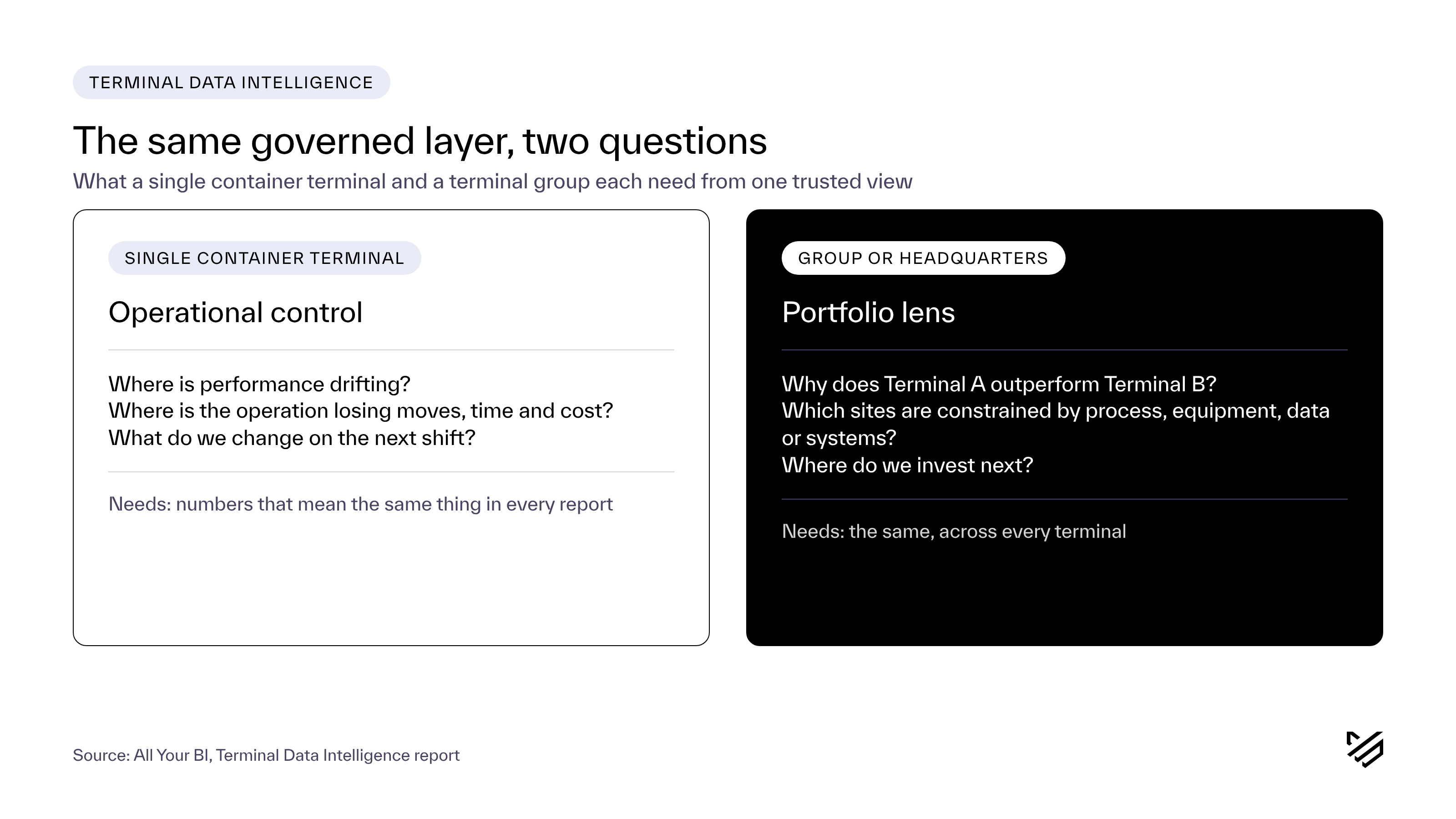
The single-terminal operator needs trusted intelligence to run the terminal better. The group leader needs it to compare, prioritize and invest across a portfolio. The same logic applies to assets: when a crane, an automation program or an equipment upgrade is questioned, the answer has to come from numbers the terminal can defend. All Your BI has described the idle time version of this in How much is idle time costing?.
What does this look like in practice?
One container terminal operation All Your BI worked with had no shortage of activity, but planning decisions were made with limited visibility across the wider system. A plan that looked workable in one part of the operation could create constraints, delays or inefficiencies somewhere else. By connecting operational data into a more usable planning environment, the terminal could see bottlenecks earlier, understand where capacity was lost and make better decisions about resource deployment.
A terminal does not always need more assets. It does need better intelligence about the assets, capacity and constraints it already has. Without that intelligence, teams work harder without the system working better.
Is the industry moving in this direction?
Yes. The industry's standards body and its benchmark both point to shared definitions rather than more technology. TIC 4.0 works on interoperability, common semantics and standardization, because terminals need shared definitions and standardized ways for systems and equipment to communicate.
The BCG and TIC 4.0 Digital Ports Benchmark supports the wider point. Digital maturity remains uneven across terminals, and data-driven intelligence is still an area where the industry needs to progress. Terminal Data Intelligence is the operator-level expression of that same direction. The port-level view is in What makes a smart port smart?.
Terminal Data Intelligence does not remove human judgment. It makes that judgment faster and better informed. A trusted view of performance becomes valuable only when it changes conversations, routines and decisions.
Key takeaways
- Terminal Data Intelligence gives every KPI one traceable definition.
- Performance meaning sits between systems.
- More dashboards do not create trusted data.
- AI amplifies the foundation beneath it, so the foundation comes first.
Ready to see what one trusted view of your container terminal looks like?
Terminal Data Intelligence is the argument. Terminal.exe is how All Your BI delivers it: one KPI definition, one lineage, one performance model across every system a terminal runs, from the TOS to the maintenance log. If your performance meetings still open with "which number are we using", start with the full report. Download the Terminal Data Intelligence report, or see how Terminal.exe builds the layer inside a live container terminal.
Frequently asked questions
What is Terminal Data Intelligence?
Terminal Data Intelligence is the governed intelligence layer that connects a container terminal's systems into one trusted view of performance. It connects the TOS with the gate, equipment, maintenance, finance and planning systems around it. Every KPI has one definition, agreed across functions, and traces back to the system it came from, so the number can be explained and defended.
Is Terminal Data Intelligence a dashboard?
No. Dashboards present numbers. Terminal Data Intelligence governs what the numbers mean across the TOS, equipment, maintenance, finance and planning systems, so dashboards built on it agree with each other. Adding dashboards on ungoverned data adds versions of the truth. Governing the data first is what makes any dashboard trustworthy.
Why does a container terminal need Terminal Data Intelligence before AI?
AI amplifies the quality of the data beneath it. On inconsistent or ungoverned terminal data, AI produces faster uncertainty rather than intelligence. A terminal is critical infrastructure, where an unreliable recommendation affects vessel, yard, gate and equipment decisions, so the governed foundation has to come first and the AI second.
Does Terminal Data Intelligence replace the terminal operating system?
No. The TOS stays the constant and keeps planning and recording the moves. Terminal Data Intelligence connects the TOS with the gate operating system, equipment control, crane management, maintenance, finance and planning systems around it into one performance model, so a move, a crane hour and a cost agree with each other.
Who delivers Terminal Data Intelligence?
All Your BI delivers it through Terminal.exe, the terminal intelligence platform that governs KPI definitions, lineage and the performance model across every system a container terminal runs. It is built for terminals and connects the TOS, gate, equipment, maintenance, finance and planning systems into one trusted foundation, with decision-ready products on top.




AYBI Thinking
At AYBi, we cut through the noise to give meaning to data. It’s not about technology — it’s about real connection. With the ambition of true data wizards, we transform insights into action. Expect everything.







Latest work
At AYBi, we cut through the noise to give meaning to data. It’s not about technology — it’s about real connection. With the ambition of true data wizards, we transform insights into action. Expect everything.