Predictive maintenance for container terminal cranes

November 5, 2026

TL;DR. Predictive maintenance for container terminal cranes depends on crane data the terminal can trust. Crane condition lives in the crane management and maintenance systems, crane utilization lives in the terminal operating system, and the two rarely agree. Terminal Data Intelligence connects them into one governed view, so a prediction about a crane rests on numbers the terminal can defend. All Your BI builds that foundation first, then the AI on top of it.
This article is for you if you're being asked to use AI for predictive maintenance on your cranes. It explains what predictive maintenance needs from terminal data, why the data foundation decides whether the prediction can be trusted, and where to start.
What is predictive maintenance for container terminal cranes?
Predictive maintenance uses the data a crane produces to predict when a component is likely to fail. Maintenance is then scheduled before the failure, instead of on a fixed interval or after a breakdown.
In a container terminal, that data is spread across the systems that each record part of the crane.
- Crane management system: Condition and events, supplied with the equipment
- Maintenance management system (CMMS): Work orders and downtime
- Terminal operating system (TOS): The moves the crane made, and when
- Equipment control system (automated terminals): Equipment commands and status
The mix differs per terminal, and each system captures only part of the reality. A prediction about a crane has to draw on all of them.
Why is crane data the first problem?
Crane data is the first problem because AI amplifies the quality of the foundation beneath it. On inconsistent or incomplete crane data, a predictive model produces an unreliable prediction. The algorithm is rarely what fails.
The risk is the quick fix: a model on top of crane data that is inconsistent between the crane system, the CMMS and the TOS. An unreliable recommendation about a quay crane affects vessel, yard and customer decisions, and a container terminal cannot afford to find that out in production. The wider argument on AI in terminals is in Container terminal automation and AI: what comes first.
What does a crane need to tell you before you can predict its failure?
A crane needs to tell you more than that it is working. It needs to tell you whether it is productive: used in the right place, at the right time, for the right operational outcome. It also needs to show whether equipment, data quality or system design limits its performance.
Activity without context hides the difference between busy cranes and productive cranes. Your terminal may know that a crane is working. It often does not know whether downtime, idle time and throughput variability on that crane are an equipment problem, a planning problem or a data problem. Without that baseline, a predictive model has nothing trustworthy to learn from, and maintenance planning stays reactive. All Your BI has written about the idle time side of this in How much is idle time costing?.
The baseline also decides the investment case. When a crane upgrade or an automation program is questioned, the answer must come from numbers the terminal can defend. Without a trusted baseline, the case for the next investment rests on the same figures nobody agreed on for the last one.
Replace equipment too early and you waste capital. Replace it too late and breakdowns stop operations. Predictive maintenance only resolves that trade-off if the numbers underneath it are governed.
How does Terminal Data Intelligence make predictive maintenance work?
Terminal Data Intelligence is the governed intelligence layer that connects a container terminal's systems into one trusted view of performance. For predictive maintenance, that means the crane system, the CMMS and the TOS feed one model, in which a crane hour, a work order and a move mean the same thing.
A predicted failure then comes with its lineage: which crane, which signals, which maintenance history, which utilization. The maintenance manager, the operations manager and the finance team see the same crane. That is the order of operations: the governed data foundation first, the AI activation second. The full argument is in What is Terminal Data Intelligence?.
What does predictive maintenance for cranes look like in practice?
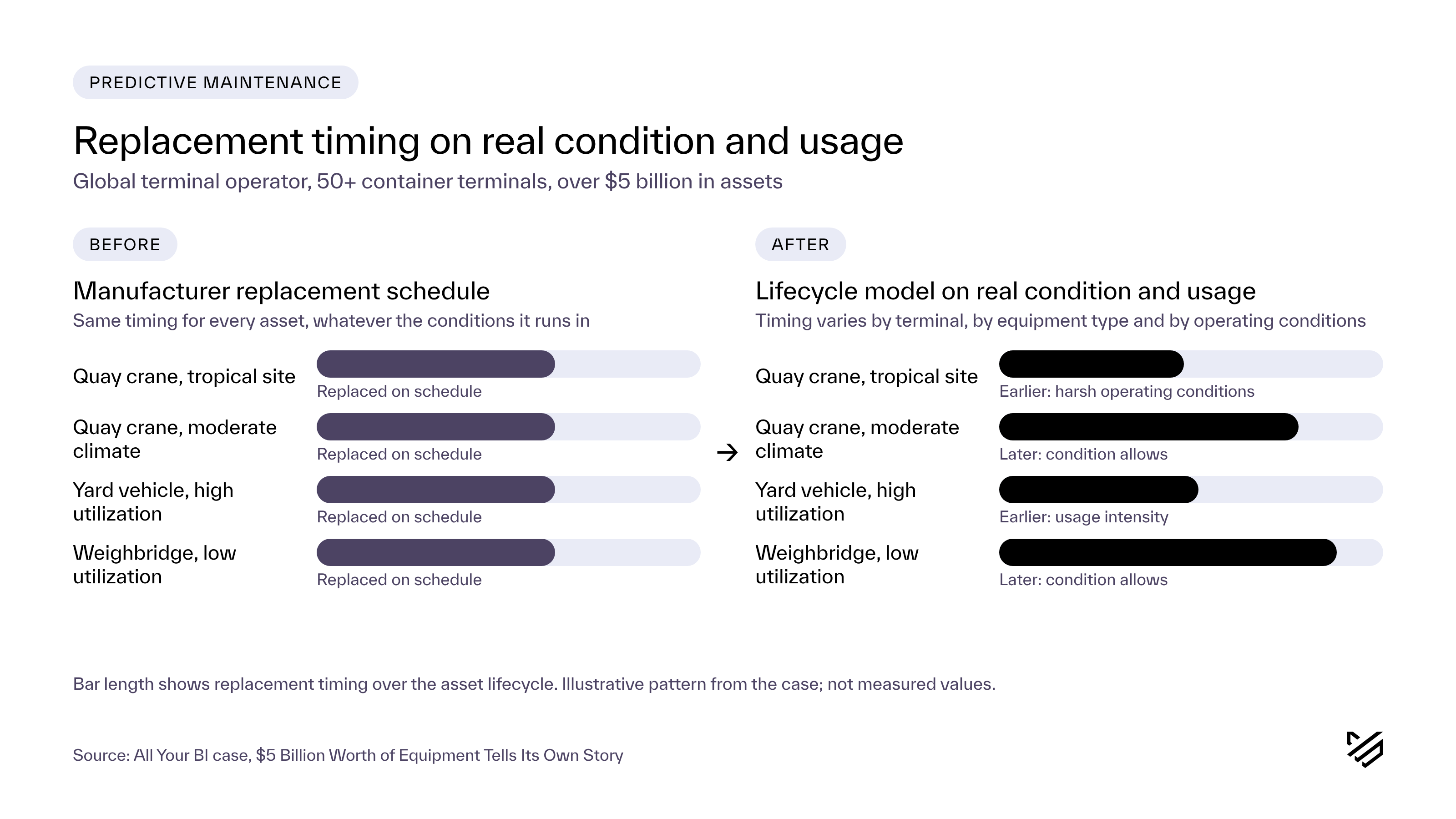
A global terminal operator with more than 50 container terminals and over 5 billion dollars in assets makes equipment investments three to five years in advance. Replacements of cranes, yard vehicles and weighbridges followed the manufacturer's schedule, whatever the conditions the equipment ran in. That produced the trade-off from the previous section: premature replacements that wasted capital, or unexpected breakdowns.
All Your BI connected the equipment data across the terminals into one asset performance management system. On that foundation it built lifecycle models on real condition and usage patterns, in place of manufacturer timelines. Replacement timing now varies by terminal, by equipment type and by operating conditions. Each terminal's procurement team works from the same models through self-service analytics.
The unified system is what made predictive maintenance possible. The foundation came first, and the prediction followed. The full case is $5 Billion Worth of Equipment Tells Its Own Story.
That's the order that matters: one trusted view of every crane across the systems that record it, then the prediction.
Key takeaways
- Crane data is spread across the crane system, CMMS and TOS.
- AI amplifies the foundation; weak crane data gives weak predictions.
- Busy cranes are not always productive cranes.
- Govern the crane data first, then add predictive maintenance.
- One operator did this across 50+ terminals and 5 billion dollars of assets.
Ready to find out whether your crane data can carry predictive maintenance?
Predictive maintenance for container terminal cranes starts with one governed view of each crane across the systems that record it. All Your BI delivers that layer through Terminal.exe: one KPI definition, one lineage, one performance model across every system a terminal runs. Read the full argument in the Terminal Data Intelligence report, or request a conversation about your cranes on the Terminal.exe page.
Frequently asked questions
What data does predictive maintenance for container terminal cranes need?
Crane condition and event data from the crane management system, work orders and downtime from the CMMS, and utilization from the TOS, connected into one governed model with one definition per measure. In automated terminals the equipment control system adds commands and status. The prediction is only as good as the agreement between those sources.
Can a terminal start predictive maintenance on its cranes without a data foundation?
It can start, but the prediction inherits the quality of the data beneath it. If the crane system, the CMMS and the TOS disagree on what a crane did and when, the model learns from the disagreement. A container terminal is critical infrastructure, so that risk is too high for a try-and-see approach.
What is the difference between a busy crane and a productive crane?
A busy crane is working. A productive crane is used in the right place, at the right time, for the right operational outcome. Activity without context hides the difference, because utilization alone does not show whether downtime, idle time and throughput variability come from the equipment, the plan or the data.
Is predictive maintenance software enough on its own?
No. Predictive maintenance software predicts from the data it gets. Without one governed view across the crane system, the CMMS and the TOS, the prediction inherits the inconsistencies between them and the maintenance team cannot trace why the model flagged a crane. The software works once the data foundation beneath it is trusted.
How does All Your BI support predictive maintenance for cranes?
All Your BI builds the governed data foundation first, so that crane condition, maintenance history and utilization agree, and then the predictive layer on top, delivered through Terminal.exe. For one global operator this covered more than 50 terminals and over 5 billion dollars in assets, moving replacement decisions from manufacturer schedules to real condition and usage.




AYBI Thinking
At AYBi, we cut through the noise to give meaning to data. It’s not about technology — it’s about real connection. With the ambition of true data wizards, we transform insights into action. Expect everything.







Latest work
At AYBi, we cut through the noise to give meaning to data. It’s not about technology — it’s about real connection. With the ambition of true data wizards, we transform insights into action. Expect everything.