Data foundation for AI: what needs to be in place before AI delivers

November 25, 2026

TL;DR. A data foundation for AI is the governed stack of data layers that your reports, analyses and AI all draw from. It has six layers, from data sources to adoption and decisions. AI needs it first, because AI amplifies the quality of the data beneath it. What a working foundation produces is data intelligence: one trusted view of how your organization performs. All Your BI builds and manages that foundation for industries that make or move things.
This article explains what a data foundation for AI consists of, why it comes before AI and how you build it. It's for you if you lead digital transformation in an organization that makes or moves things, and AI is on your agenda.
Why does almost no one have data that AI can trust?
Most organizations now have AI tools. Few have data those tools can rely on.
AI tools are easy to buy. Your organization can license a model, connect it to a few systems and have a working demonstration within weeks. What you cannot buy is the thing the model depends on: data that means the same in every system and every team.
In industries that make or move things, that data sits in many places. Operations, maintenance, planning and finance each run their own systems, and each system holds part of the picture. Reporting grew around those systems over the years. The result is fragmented views, department-specific definitions, and limited trust in the numbers.
As AI becomes the operating standard, the tools you choose matter less than what they run on. The outcome depends on whether your data foundation can support them.
What is a data foundation for AI?
A data foundation for AI is the stack of data layers that your reports, analyses and AI all draw from. All Your BI describes it in six layers:
- Data sources
- Data quality and governance
- Data platform
- Data modeling
- BI and AI
- Adoption and decisions
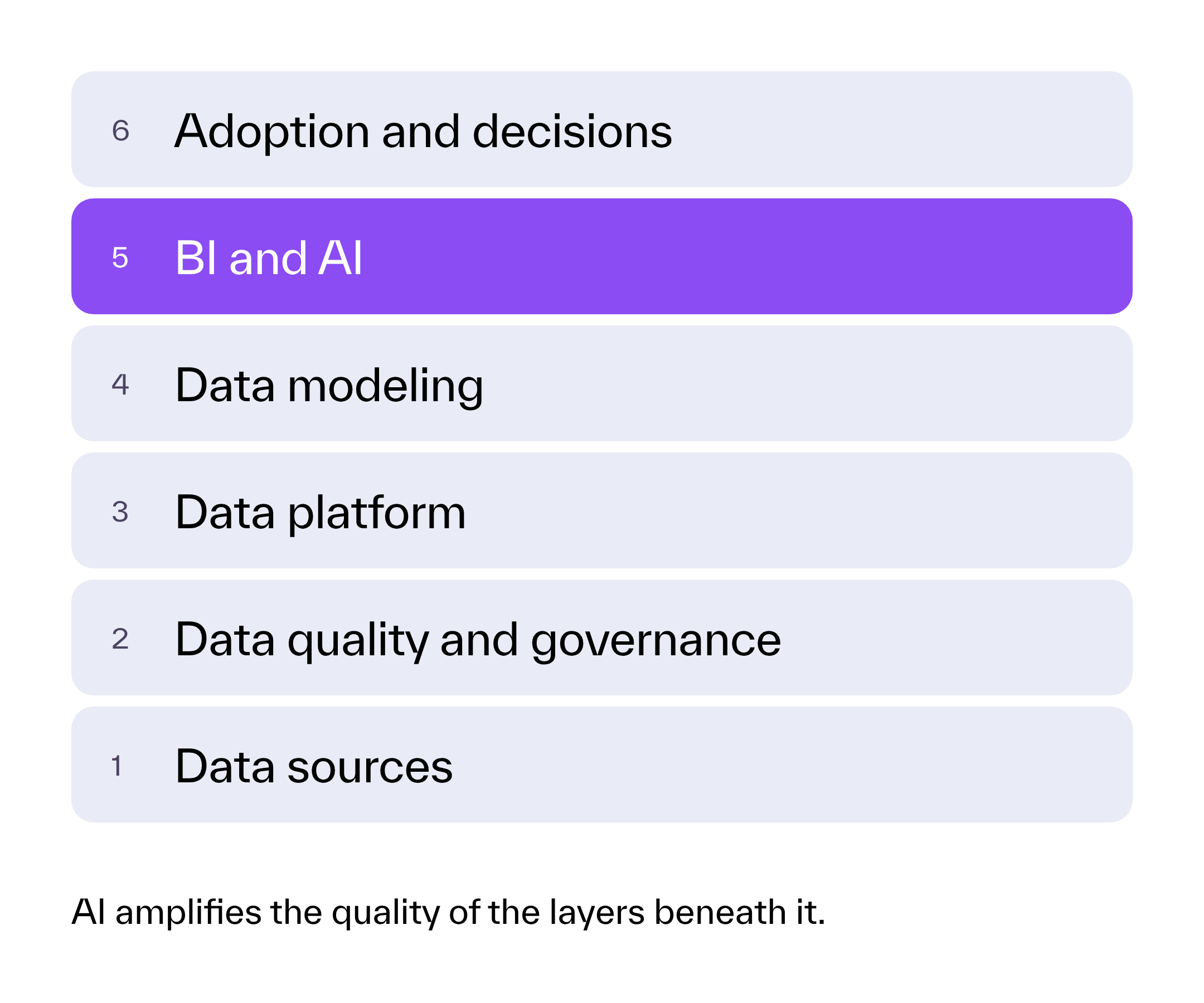
Every layer exists in some form in every organization. Maturity means consolidating those layers, from Excel exports per department into one governed stack across the organization.
You build the foundation once and reuse it. Every source lands once and is modeled once, so a number means the same thing in every report and every model.
A foundation that nobody uses carries nothing. Data maturity is an organizational matter, shaped by culture, behavior and decision-making as much as by systems.
The same applies to a platform. In one case All Your BI worked on, the data capability already existed. The platform still had to become stable, governed and embedded in leadership routines before it changed a decision.
Building the foundation does not mean replacing your systems. Established container terminals, for example, run on systems that have been part of their processes for years. Many of those systems were never designed for modern analytics or AI. The work is to connect what matters into one trusted foundation.
Why does the data foundation come before AI?
AI amplifies the quality of the foundation beneath it. If that foundation is weak, the AI output is weak and unreliable. A model works with the data it is given and cannot correct definitions it does not know about.
You cannot build trustworthy AI on fragmented data or scale automation on inconsistent definitions. Confident operational decisions don't come from reports someone has to reconcile first.
All Your BI's manufacturing framework reaches the same conclusion. Without trust in data, clear governance and consistent use across the organization, automation amplifies errors. Flexible robotics, digital twins and AI-enabled scheduling each depend on reliable, shared data to deliver value in practice.
That sets the order of operations: data foundation first, AI activation second.
Skipping that order has a price. All Your BI calls it AI waste: money spent on AI that cannot land because the data underneath it cannot carry it. Every AI project your organization funds sits on the same foundation. That foundation is either an asset that compounds or a tax on everything built on top of it.
One global terminal operator shows the order in practice. All Your BI first connected equipment data from more than 50 container terminals into one asset management system. That unified system is what made predictive maintenance possible. The case is $5 Billion Worth of Equipment Tells Its Own Story.
What does data intelligence mean?
Data intelligence is what a working data foundation produces. It is the governed layer that connects your organization's systems into one trusted view of how it performs. Every number in that view has one definition and traces back to the system it came from.
Each word in that definition does work:
- Governed: every number can be traced to its source, so you can explain and defend it.
- Connected: the systems that each hold part of the picture feed one model.
- Trusted: a KPI means the same in every report, every team and every leadership conversation.
Having data alone does not produce that view. Your organization can have a strong platform with weak adoption, many reports with little governance, or dashboards that describe activity without changing a decision. Data maturity is the ability to collect, govern, trust, use and act on data across people, technology and processes. Data intelligence is what that ability produces.
Maturity covers more than technology. It also covers analytical capability, ownership, training, culture and the routines through which people use data in daily decisions.
For container terminals, All Your BI has worked this out in detail. Read the container terminal version: What is Terminal Data Intelligence?
How do you build the data foundation?
Building the foundation comes down to four questions. Each has its own article in this series.
| Your question | What the answer gives you | Read on |
|---|---|---|
| Is our data ready for AI? | Your position on a maturity path of six stages, and what AI can be trusted with at each one | AI readiness assessment: how to tell whether your data is ready for AI |
| Why do our reports show different numbers? | One definition and one source per KPI | Data quality: why your reports show different numbers |
| Who owns which data? | Named owners, for data and for every AI system | Data governance: who owns which data |
| In what order do we build? | A staged path from separate reports to a reusable foundation | Data strategy: how to move from separate reports to a reusable foundation |
The questions depend on each other. So you answer them together.
What does this look like in a factory and in a container terminal?
In manufacturing, the pattern starts with reporting that has grown organically. Different teams rely on different reports or read the same figures in different ways. Data then becomes a source of debate, decisions are delayed, and confidence erodes. Energy is a common example in All Your BI's Data Maturity in Manufacturing report. Many manufacturers already collect large amounts of energy data and struggle to use it consistently in decisions.
In a container terminal, the pattern shows up in the Monday performance meeting. Moves per hour were below commitment. The terminal cannot trace the miss quickly enough to the combination of berth, yard, equipment and planning decisions behind it. The meeting ends with the same explanation as last time.
Once the foundation is in place, the conversation changes in both. Teams rely on shared information during meetings, shift handovers and performance reviews. That reduces debate over numbers and shifts the conversation to actions and priorities.
Key takeaways
- A data foundation is built once and reused for every question.
- AI amplifies the foundation beneath it.
- The order is fixed: foundation first, AI second.
- Data intelligence is the trusted view the foundation produces.
Ready to see where your data foundation stands?
All Your BI is the data intelligence partner for industries that make or move things. The quickest check is the AI Readiness Scan: fifteen minutes, free, no preparation. If you run a container terminal, the Terminal Data Intelligence report makes the full argument for your operation. For manufacturing, Data Maturity in Manufacturing shows where your organization stands and what to fix next.
Frequently asked questions
What is a data foundation for AI?
A data foundation for AI is the governed stack of six data layers that reports, analyses and AI all draw from. The layers are data sources, data quality and governance, the data platform, data modeling, BI and AI, and adoption and decisions. Every source lands once and is modeled once, so each new question reuses the same numbers.
Why does AI need a data foundation first?
AI amplifies the quality of the data beneath it. A model cannot correct definitions it doesn't know, so inconsistent data produces unreliable output faster. That is why the order of operations is fixed: build the data foundation first, then activate AI on top of it.
What is data intelligence?
Data intelligence is the governed layer that connects an organization's systems into one trusted view of how it performs. Every number has one definition and traces back to its source system. Operations, maintenance, planning and finance then work from the same figures, so a KPI means the same in every report and meeting.
What is AI waste?
AI waste is money spent on AI that cannot land because the data underneath it cannot carry it. Every AI project sits on the same data foundation, so a weak foundation taxes each of them. A strong foundation works the other way: it is an asset that compounds with every project.
What does data readiness for AI mean?
Data readiness for AI describes whether your data is governed, connected and trusted enough to make AI useful, safe and repeatable. It is a maturity question with six stages, from unstructured data to AI embedded in daily decisions. How to assess it is covered in AI readiness assessment: how to tell whether your data is ready for AI.




AYBI Thinking
At AYBi, we cut through the noise to give meaning to data. It’s not about technology — it’s about real connection. With the ambition of true data wizards, we transform insights into action. Expect everything.







Latest work
At AYBi, we cut through the noise to give meaning to data. It’s not about technology — it’s about real connection. With the ambition of true data wizards, we transform insights into action. Expect everything.